We will be attempting to replicate a traditional Greek set design for this production. Skenographia, Greek sets, were introduced by Sophocles. These were often in the form of Periaktoi, three sided canvas units that rotated to display different settings. Perhaps more important than just backgrounds, however, are the props of the show. As the patron system of Ancient Greek theatre left shows with indeterminate budgets during the writing process, playwrights tended to shy away from describing elaborate backgrounds. Instead they focused on creating props and objects that can be interacted with. These include walls and doors; things that the actors can interact with that need not look like a particular thing. For more information see the following: Skenographia
Source:
Maitland, Judith. "Controversy and Clues: Recovering and Recreating Graeco-Roman Scenography." Theatre Arts Journal 1.1 (2009). Print.
Monday, November 8, 2010

Masks
In the video above you can see the use of traditional Greek masks used in a contemporary production of Oedipus. This will provide you an idea of what it is like to work with masks. Masks a central part of traditional Greek theatre. They provdide the audience with a clear view of who the character is. The specific expression on the mask informs the audience of the emotions of the character. I highly recomend you go to the following sight and watch th erest of the videos on mask usage:
Aeacus
Aeacus is one of the judges of the underworld. He once was the king of the island of Aegina. He was beloved by the gods. He is most famous for praying to the gods for more people after his kingdom was desolated by diseased. The gods answered by turring ants into people, dubbed the Myrmidons. The Myrmidons went on to be led by Achilles in the Trojan war. After his death he was made into one of the judges of the underworld, along with Rhadamanthys and Minos.
Source:
"Aeacus." Encyclopedia Mythica: Mythology, Folklore, and Religion. Web. 07 Nov. 2010. <http://www.pantheon.org/articles/a/aeacus.html>.
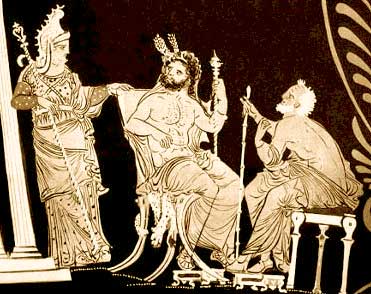 |
| Rhadamanthys Minos and Aeacus |
Source:
"Aeacus." Encyclopedia Mythica: Mythology, Folklore, and Religion. Web. 07 Nov. 2010. <http://www.pantheon.org/articles/a/aeacus.html>.
Dionysus
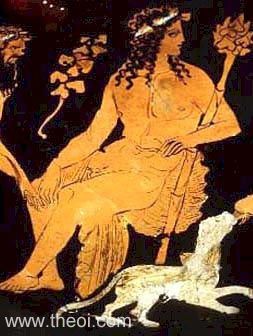 | |
| Dionysus |
Dionysos
Source:
"Dionysus" World Encyclopedia. Philip's, 2008. Oxford Reference Online. Oxford University Press. Central Washington University. 8 November 2010 <http://www.oxfordreference.com/views/ENTRY.html?subview=Main&entry=t142.e3344>
Greek Theatres
In order to develop your understanding of the traditional way in which these scripts were performed I would like you to comprehend the magnitude of Greek theatres. Most modern Broadway theatres average around one thousand seats. Anything over 2000 is considered huge. The Theatre of Dionysus in Athens held Seventeen-Thousand People! Greek plays are written to be performed to huge audiences at great distances. You must take this in to consideration in your work. Please take the virtual tours of the theatre of Dionysus and other Greek theatres and explore the raw magnitude of them.
Theatre of Dionysus
Other Greek Theatres
Theatre of Dionysus
Other Greek Theatres
Script
Far and away the single most important thing you can do as actors to prepare for this production is to familiarize yourself with the script. As such I have included a link to the entirety of the script. You will be provided a print version in time but please familiarize yourself with this version to begin.
The Frogs
In addition to reading The Frogs, I would like you to take the time to study the works of other Greek playwrights. A large portion of The Frogs is spent on the debate between rescuing Euripides or Aeschylus. As such I have provided links to the main works of both playwrights. Please read the following:
The Bacchae
This work by Euripides follows Dionysus on his quest for revenge against Pentheus, king of Thebes. This will provide you with an idea of the early Greek view of Dionysus. (Note: The Bacchae begins halfway down this page)
The Cyclops
This play by Euripides is the only intact Satyr play we posses. It relates the story of Odysseus' encounter with the Cyclops. This play is the closest to a comedy we possess from the works of Euripides.
The Orestia
The Orestia by Aeschylus is the only surviving trilogy of Greek drama. Reading this will not only provide you with a background to who Aeschylus is, it will also help you to understand how Greek drama was structured over trilogies.
The Frogs
In addition to reading The Frogs, I would like you to take the time to study the works of other Greek playwrights. A large portion of The Frogs is spent on the debate between rescuing Euripides or Aeschylus. As such I have provided links to the main works of both playwrights. Please read the following:
The Bacchae
This work by Euripides follows Dionysus on his quest for revenge against Pentheus, king of Thebes. This will provide you with an idea of the early Greek view of Dionysus. (Note: The Bacchae begins halfway down this page)
The Cyclops
This play by Euripides is the only intact Satyr play we posses. It relates the story of Odysseus' encounter with the Cyclops. This play is the closest to a comedy we possess from the works of Euripides.
The Orestia
The Orestia by Aeschylus is the only surviving trilogy of Greek drama. Reading this will not only provide you with a background to who Aeschylus is, it will also help you to understand how Greek drama was structured over trilogies.
Frog Physicality
It will be extremely important for all chorus members to gain an understanding of frog physicality. Each actor must master the unique gate and posture of frogs. For the purposes of this production we will be mimicing the common tree frog, native to Greece. Below you will find an example.
 |
| The Common Tree Frog |
Take note of the frogs hands. They are 3 fingered creatures. As such you will all be wearing 3 fingered gloves. You should begin practicing using your hands in this method now.
 |
| Frog Hand |
You also must learn how to move like a tree frog. Please watch the video below. Pay attention to the side-to-side waddle of the frog. Also make note of how he moves his legs - Front left followed immediatly by rear right, then front right followed immediatly by rear left.
Sources:
Bohdal, Jiri. Common Tree Frog. 2005. Photograph. Czech Republic. NaturePhoto-CZ. Apr. 2005. Web. 7 Nov. 2010. <http://www.naturephoto-cz.com/common-tree-frog:hyla-arborea-photo-910.html>.
Live Long and Prosper. Photograph. Healthy Living. Dec. 2007. Web. 7 Nov. 2010. <http://www.brendawatson.com/Healthy-Living/200712/your-liver-speaks-up.htm>.
Red Eyed Tree Frog - SO CUTE! Youtube. 20 June 2007. Web. 7 Nov. 2010. <http://www.youtube.com/watch?v=_qiDiHLAsKc>.
Monday, November 1, 2010
Time Period
http://www.oxfordreference.com.ezp.lib.cwu.edu/views/TIMELINES.html?subview=timeline&topic=th15&moment=m10090#-421
Charon
Charon is a central figure in the life of the underworld. Everyone must travel across the Acheron, the "river of woe," on their way to Hades. Charon is the only boatman on the river and as such Charon plays a key role in the life, or more accurately death, of every mortal. Charon charges a fee of an obolus, an ancient Greek coin. This is why the ancient Greeks buried their dead with a coin under the tongue. The exchange below demonstrates the importance of having a coins. The Corpse is only willing to help for decent ammount of money, enough to ferry himself and others across.
DIONYSUS
Good.
And see they are carrying out a body now.
Here a CORPSE, wrapped in its grave-clothes, and lying on a bier, is carried across the stage.
Hallo! you there, you deadman, are you willing
To carry down our little traps to Hades?
CORPSE
What are they?
DIONYSUS
These.
CORPSE
Two drachmas for the job?
DIONYSUS
Nay, that's too much.
CORPSE
Out of the pathway, you!
DIONYSUS
Beshrew thee, stop: may-be we'll strike a bargain.
CORPSE
Pay me two drachmas, or it's no use talking.
DIONYSUS
One and a half.
CORPSE
I'd liefer live again I
XANTHIAS
How absolute the knave is! He be hanged!
I'll go myself.
http://www.pantheon.org/articles/c/charon.html
DIONYSUS
Good.
And see they are carrying out a body now.
Here a CORPSE, wrapped in its grave-clothes, and lying on a bier, is carried across the stage.
Hallo! you there, you deadman, are you willing
To carry down our little traps to Hades?
CORPSE
What are they?
DIONYSUS
These.
CORPSE
Two drachmas for the job?
DIONYSUS
Nay, that's too much.
CORPSE
Out of the pathway, you!
DIONYSUS
Beshrew thee, stop: may-be we'll strike a bargain.
CORPSE
Pay me two drachmas, or it's no use talking.
DIONYSUS
One and a half.
CORPSE
I'd liefer live again I
XANTHIAS
How absolute the knave is! He be hanged!
I'll go myself.
http://www.pantheon.org/articles/c/charon.html
A Sampling of The Frogs
This video shows samplings of The Frogs as performed by the Greek theatre company, Periaktoi. Watch through to get an idea of the sound of the play in its native tongue. Pay close attention to the flow of the language when the chorus of frogs takes the stage.Also take note of the animation of the dialogue. The text requires a certain life in the readings to truly show itself off.
http://www.youtube.com/watch?v=6jK2hS1_Jug
http://www.youtube.com/watch?v=6jK2hS1_Jug
Subscribe to:
Comments (Atom)